
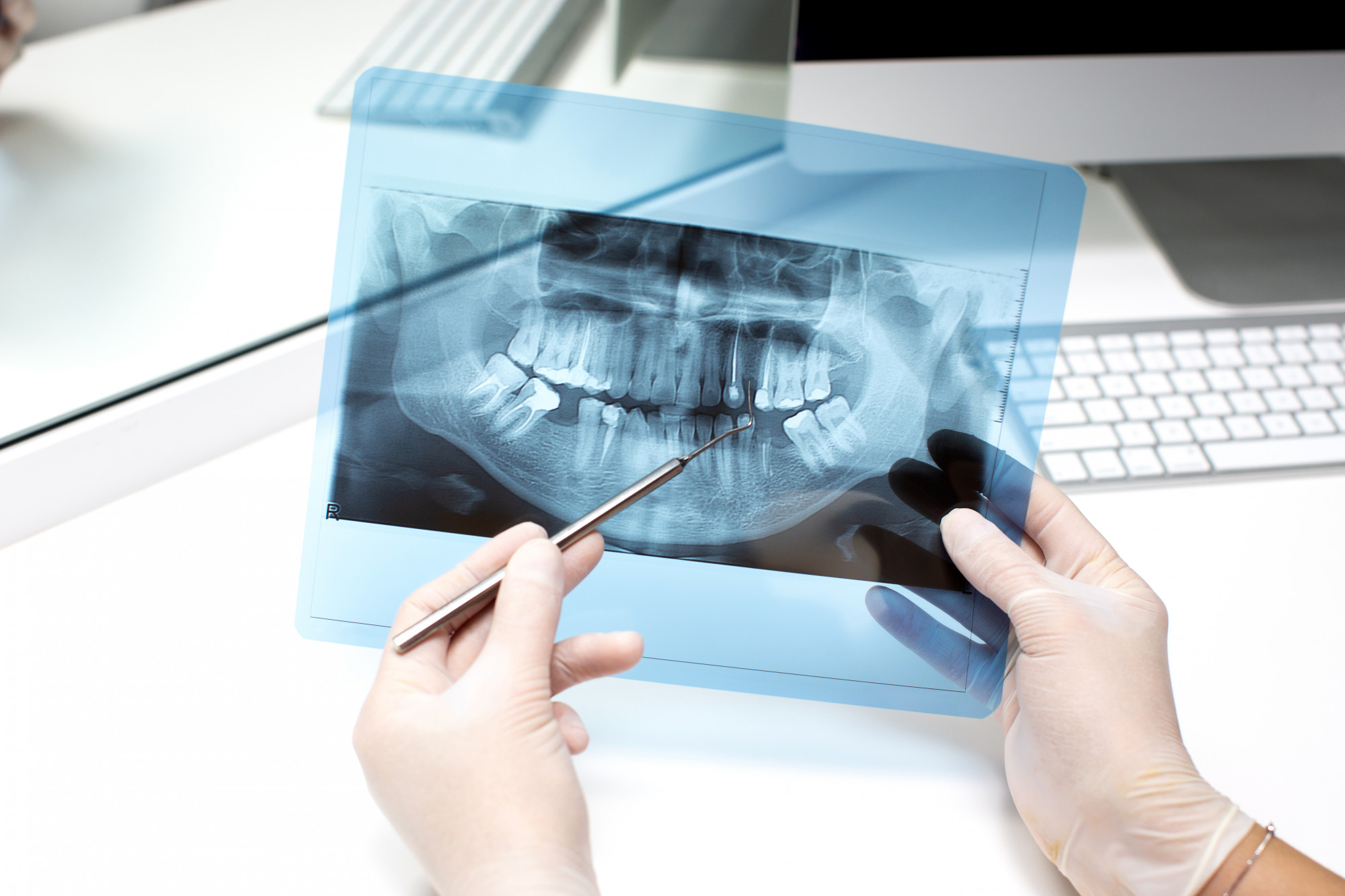
Radiographs (Dental X-Rays)
Dental X-rays are one of the most valuable diagnostic tools in modern dentistry — and one of the most misunderstood. Many patients wonder whether they are really necessary at every stage of care, or whether the radiation exposure is a concern. At SmileVerse Dental Clinic in Friendswood, TX, Dr. Greiss uses digital radiography exclusively — a technology that not only produces sharper, more detailed images than traditional film X-rays, but does so with up to 90 percent less radiation exposure. The result is a diagnostic tool that is safer, faster, and more informative than ever before, and that allows Dr. Greiss to see what no visual examination alone can reveal.
The human eye is extraordinarily good at detecting surface changes in teeth and gum tissue — but it cannot see through the enamel, between the contact points of adjacent teeth, beneath existing restorations, inside the jawbone, or below the gum line. These are precisely the places where some of the most clinically significant dental problems develop. Decay forming between two teeth that look perfectly normal on the surface, an infection growing silently at the tip of a tooth root, early bone loss from undetected gum disease, a cyst developing in the jaw without any symptoms — these are conditions that X-rays routinely identify and that would otherwise go undiagnosed until they became significantly more serious and expensive to treat.
At SmileVerse, X-rays are taken with clinical purpose, not on a fixed schedule regardless of need. Dr. Greiss determines the type and frequency of imaging based on your individual clinical history, the findings of your current exam, any symptoms you have reported, and your overall risk profile for decay and gum disease. New patients typically receive a full-mouth series of X-rays to establish a complete diagnostic baseline. After that, bitewing X-rays — which show the contact areas between the back teeth where cavities most commonly form — are typically updated every 12 to 24 months depending on your risk level. Periapical X-rays, which show individual teeth from crown to root tip, are taken when a specific concern needs to be evaluated in more detail.
Digital X-rays appear on-screen within seconds of being taken, and Dr. Greiss reviews them with you immediately during the appointment. You will see exactly what he sees, and he will explain any findings in plain language — pointing to areas of concern and describing what they represent and what the options are. This transparency is a fundamental part of how we practice at SmileVerse. You should always understand what is happening in your own mouth, and X-rays make that conversation specific and visual rather than abstract.
For patients who have concerns about radiation, it is worth noting that the dose from a full set of digital dental X-rays is comparable to the background radiation you receive during a short airplane flight — a fraction of what is encountered in daily life. Dr. Greiss will always discuss any X-ray recommendation with you if you have questions, and will explain exactly which images are needed and why. Informed, purposeful imaging is always the standard at SmileVerse.
What to Expect at SmileVerse
✦ Clinical assessment first: Dr. Greiss determines which X-rays are indicated based on your history, symptoms, and current exam findings before any images are taken.
✦ Quick, comfortable imaging: Digital sensors are placed gently in the mouth and images appear on-screen within seconds — faster and more comfortable than traditional film X-rays.
✦ Immediate review: Dr. Greiss walks you through the images at your appointment, explaining exactly what is visible and what it means clinically.
✦ Low radiation exposure: All imaging at SmileVerse uses digital technology with up to 90% less radiation than conventional film.
✦ Documentation and comparison: Images are saved to your patient file and compared at future visits to detect and track any changes over time.
Frequently Asked Questions
Q: Are dental X-rays safe?
A: Yes.
Digital dental X-rays use a very small amount of radiation — far less than
conventional film X-rays and comparable to a fraction of natural daily
background radiation. The diagnostic benefit of finding problems early far
outweighs the minimal exposure risk for the vast majority of patients.
Q: Do I need X-rays at every visit?
A: No.
The frequency of X-rays is determined by your individual clinical situation.
Patients with a history of frequent decay or active gum disease typically need
them more often than patients with consistently stable oral health.
Q: What can dental X-rays detect that a
visual exam cannot?
A: Cavities
forming between teeth, bone loss from gum disease, infections at root tips,
cysts or tumors in the jaw, impacted teeth, and changes in bone density are
among the conditions routinely identified only on X-rays.
Q: I’m pregnant. Can I still get dental
X-rays?
A: Dental
X-rays during pregnancy are generally considered safe when clinically
necessary, particularly with digital technology and the use of a leaded apron.
Dr. Greiss will discuss your specific situation and defer non-urgent X-rays to
after delivery when appropriate.
Q: How are dental X-rays different from the
CBCT 3D scans?
A: Standard dental X-rays produce two-dimensional images used for routine diagnosis. CBCT produces a three-dimensional image of the full jaw reserved for complex cases such as implant planning and surgical extractions. Both are available in-house at SmileVerse.
Ready to get started? Call SmileVerse at (281) 482-3331 or book online at smileverseclinic.com. We proudly serve Friendswood, League City, Pearland, Clear Lake, and the greater Houston area.