
Dental Bridges
A missing tooth does far more damage than most people realize. Beyond the visible gap in your smile, an untreated missing tooth creates a cascade of consequences that affect your bite, the alignment of neighboring teeth, the health of your jawbone, and even the shape of your face over time. At SmileVerse Dental Clinic in Friendswood, TX, Dr. Greiss offers dental bridges as one of the reliable, time-tested solutions for replacing one or more missing teeth — restoring the function and aesthetics of your smile without the wait or surgical procedure required for implants, and without the removability of a partial denture.
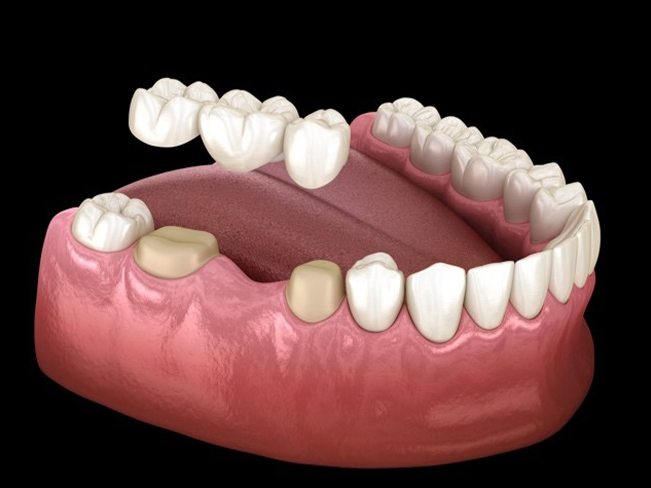
A traditional dental bridge consists of one or more artificial teeth — called pontics — held in place by dental crowns that are bonded to the healthy teeth on either side of the gap. These anchor teeth, called abutments, are prepared in the same way as teeth being fitted for individual crowns, and the bridge structure is fabricated as a single, unified restoration that fits seamlessly across the gap. The result is a fixed, non-removable replacement that restores your ability to chew, speak clearly, and smile without self-consciousness. A well-made bridge is difficult to distinguish from natural teeth and distributes chewing forces evenly across the supporting abutments.
Bridges serve multiple important functions beyond pure aesthetics. When a tooth is missing, the neighboring teeth on either side have a natural tendency to drift into the space over time — a process called mesial drift. This shifting can cause misalignment of the bite, uneven wearing of the teeth, and difficulty cleaning areas that were previously accessible. Similarly, the tooth in the opposite arch that previously made contact with the lost tooth may begin to over-erupt — elongating gradually into the empty space — which further disrupts bite function. A bridge fills the gap before any of these changes can occur or worsens, preserving the arrangement of the remaining teeth.
For patients who are not candidates for dental implants — either due to bone loss, medical considerations, or personal preference — a bridge provides a fixed, stable, and comfortable alternative. Bridges can also be supported by dental implants rather than natural teeth in some cases, which eliminates the need to crown the adjacent teeth and provides the additional benefit of bone stimulation in the area of the missing tooth. Dr. Greiss will discuss all available options during your consultation and help you identify the solution that best fits your clinical situation, timeline, and budget.
The process of receiving a dental bridge at SmileVerse typically involves two appointments. At the first, the abutment teeth are prepared, digital impressions are taken, and temporary coverage is placed. The custom bridge is fabricated by our dental laboratory over the following two to three weeks, after which you return for the delivery appointment — during which Dr. Greiss ensures the fit, aesthetics, and bite are perfect before permanently cementing the restoration in place. With proper hygiene — including the use of floss threaders or a water flosser to clean beneath the pontic — a quality dental bridge can last 10 to 15 years or longer.
What to Expect at SmileVerse
✦ Consultation and evaluation: Dr. Greiss evaluates your oral health, the condition of the abutment teeth, and bone health to confirm that a bridge is the appropriate and predictable solution.
✦ Tooth preparation: The abutment teeth are shaped to receive the crowns, impressions are taken, and temporary coverage is placed.
✦ Custom fabrication: Your bridge is crafted by a dental laboratory to your precise specifications over approximately two to three weeks.
✦ Bridge delivery and adjustment: The bridge is tried in for fit and aesthetics, adjusted as needed, and permanently cemented in place.
✦ Hygiene guidance: Dr. Greiss demonstrates proper cleaning technique for the bridge, including how to clean beneath the pontic.
Frequently Asked Questions
Q: How long does a dental bridge last?
A: A well-maintained bridge typically lasts 10–15 years. The longevity depends on the health of the abutment teeth, your oral hygiene practices, and any habits like grinding.
Q: Does getting a bridge hurt?
A: The procedure is performed under local anesthesia, so discomfort during treatment is minimal. Some sensitivity in the abutment teeth after preparation is normal and temporary.
Q: How do I clean under a bridge?
A: Floss threaders, dental picks, or a water flosser allow you to clean beneath the pontic effectively. Our team will demonstrate the technique at your delivery appointment.
Q: Is an implant better than a bridge?
A: Implants preserve jawbone, do not require alteration of adjacent teeth, and can be easier to clean. However, bridges are an excellent solution for many patients — particularly when the adjacent teeth already need crowns. Dr. Greiss will help you weigh both options.
Q: Can I eat normally with a bridge?
A: Yes. Once cemented, a bridge restores normal chewing function. Extremely hard or sticky foods should be avoided to protect the restoration.
Ready to get started? Call SmileVerse at (281) 482-3331 or book online at smileverseclinic.com. We proudly serve Friendswood, League City, Pearland, Clear Lake, and the greater Houston area.